PC Brands Compared: Choosing the Right Manufacturer for Your Needs [2026]
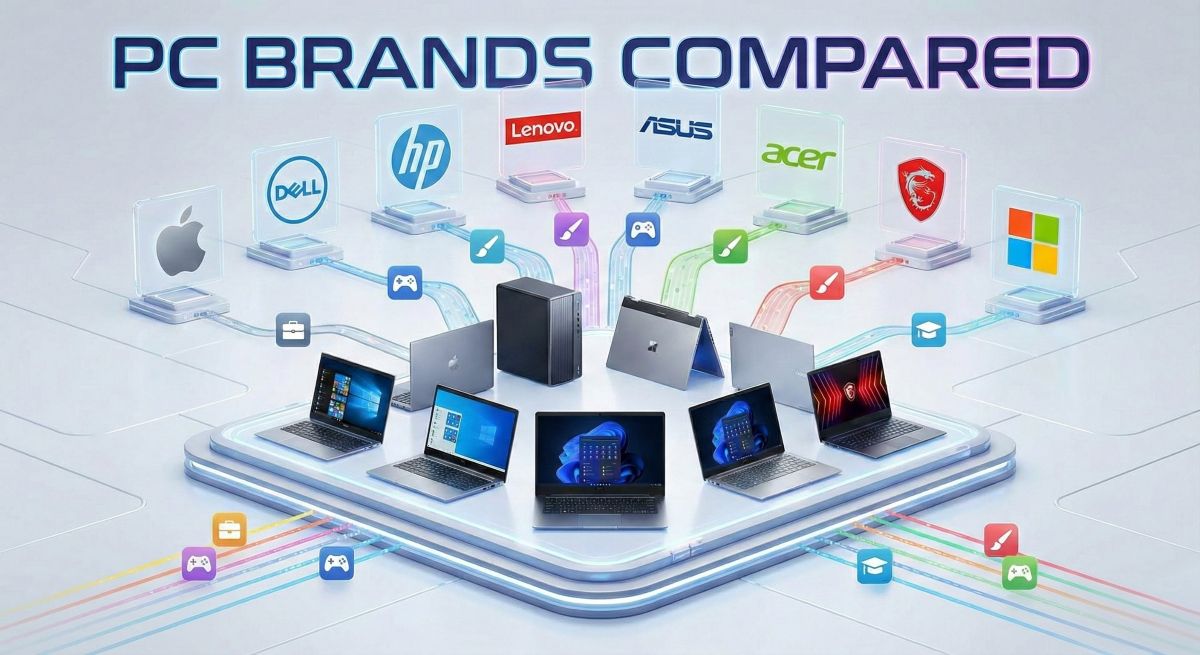
Not sure which PC brand to choose? With so many manufacturers offering laptops, desktops, and 2-in-1s, picking the right brand can feel overwhelming. Each company has its own strengths, product families, and target audiences—and understanding these differences can save you time and money.
In this comprehensive guide, we break down the major PC brands, explain their product lineups, and help you identify which manufacturer best fits your needs—whether you’re a business professional, gamer, creative, or everyday user.
PC Brand Overview: At a Glance
Before diving deep into each brand, here’s a quick comparison of what each manufacturer is best known for:
| Brand | Best Known For | Primary Audience |
|---|---|---|
| Apple | Ecosystem integration, build quality, Apple Silicon | Creatives, professionals, Apple ecosystem users |
| Dell | Business solutions, broad portfolio, enterprise support | Businesses, enterprises, gamers (Alienware) |
| HP | Security features, business reliability, wide availability | Businesses, students, consumers |
| Lenovo | ThinkPad durability, keyboard quality, enterprise features | Business professionals, enterprise IT |
| ASUS | Gaming (ROG), innovation, OLED displays | Gamers, creators, tech enthusiasts |
| Acer | Value for money, clear product segmentation | Budget-conscious buyers, students, casual gamers |
| MSI | Gaming performance, high-end specs, cooling | Gamers, power users, creators |
| Microsoft | Windows integration, premium design, touch/pen | Professionals, Surface enthusiasts |
Global PC Brands Explained
🍎 Apple (Mac)
What makes Apple different: Apple is the only major PC maker that controls the entire stack—hardware, operating system (macOS), and now its own Apple Silicon chips. This vertical integration results in exceptional consistency, optimization, and a seamless experience across devices.
Main Product Families
- MacBook Air — Thin, light, long battery life. The “everyday laptop” for most people.
- MacBook Pro — Higher sustained performance, better displays, more ports. For creators and developers.
- iMac — All-in-one desktop with stunning display. Ideal for home and office.
- Mac mini — Compact desktop. Great value if you have your own monitor.
- Mac Studio / Mac Pro — High-end desktops for professional workflows.
💻 Dell
What makes Dell different: Dell offers one of the broadest portfolios in the industry, spanning consumer, business, and professional workstation segments. They’re particularly strong in enterprise deployment with excellent support options.
Main Product Families
- Inspiron — Mainstream consumer family for home and school use.
- Dell Pro / Pro Max — Business-focused with manageability and security features.
- OptiPlex — Iconic business desktop line with multiple form factors.
- Alienware — Premium gaming brand with distinctive design.
🖥 HP
What makes HP different: HP maintains one of the broadest Windows PC portfolios with especially clear separation between consumer style machines, gaming rigs, and business/security-focused lines.
Main Product Families
- ENVY — Premium mainstream consumer laptops.
- Spectre — Flagship premium line with cutting-edge design.
- OMEN — Gaming-focused family with high-end options.
- ProBook — Mainstream business value.
- EliteBook — Higher-end business with enhanced security and manageability.
- ZBook — Mobile workstations for CAD, 3D, and engineering.
🛠️ Lenovo
What makes Lenovo different: Lenovo owns the most recognizable business laptop identity in the market (ThinkPad), while still offering tremendous breadth in consumer and gaming segments.
Main Product Families
- ThinkPad — Business flagship. Legendary durability, excellent keyboards, enterprise features.
- ThinkBook — Small-business and prosumer bridge between ThinkPad and consumer.
- Yoga — Premium line focused on convertible 2-in-1 designs.
- IdeaPad — Mainstream consumer laptops.
- Legion — Gaming and performance-focused line.
🎮 ASUS
What makes ASUS different: ASUS is known for fast-moving innovation in form factors and displays, plus one of the strongest gaming ecosystems (ROG). They’ve also heavily pushed OLED panels across many price tiers.
Main Product Families
- Zenbook — Premium thin-and-light laptops with sleek design.
- Vivobook — Mainstream consumer laptops.
- ROG (Republic of Gamers) — Flagship gaming and performance line.
- TUF Gaming — Value gaming with durability and price/performance focus.
- ProArt — Creator-focused laptops with color-accurate displays.
- ExpertBook — Business-oriented ultraportables.
💲 Acer
What makes Acer different: Acer offers strong value coverage with clearly defined “family roles,” making it easier to understand what each product line is designed for.
Main Product Families
- Aspire — Everyday laptops, budget to midrange.
- Swift — Thin-and-light premium ultraportables.
- Nitro — Entry to mid-level gaming.
- Predator — High-end gaming brand.
- TravelMate — Business-focused mobility.
🔥 MSI
What makes MSI different: MSI is heavily performance-centric, best known for gaming laptops and increasingly for creator/pro laptops with high-power components and aggressive cooling.
Main Product Families
- Titan — Desktop-replacement flagship gaming laptops.
- Gaming Series — High refresh displays and advanced cooling systems.
- Prestige — Business/productivity premium with thin aluminum builds and longer battery.
🖥️ Microsoft (Surface)
What makes Surface different: Microsoft designs Surface devices as “reference” Windows PCs—showcasing tight Windows integration, premium build quality, and strong pen/touch experiences.
Main Product Families
- Surface Pro — 2-in-1 detachable (tablet + keyboard accessory).
- Surface Laptop — Classic clamshell premium laptop.
- Surface Go — Compact, affordable tablet option.
- Surface Studio — Creative-focused all-in-one desktop.
Japan-Focused PC Manufacturers
These brands have strong presence in the Japanese market and are known for specific characteristics valued by domestic business and consumer users:
🇯🇵 Popular in Japan
| Brand | Product Lines | Key Identity |
|---|---|---|
| Panasonic | Let’s Note | Ultralight + rugged + business ports, built for mobile work styles |
| Fujitsu | FMV / LIFEBOOK / ESPRIMO | Strong domestic lineup split between notebooks (LIFEBOOK) and desktops (ESPRIMO) |
| Dynabook | Tecra / Satellite / Portege | Business-oriented laptop families with long heritage |
| VAIO | SX / F Series | Premium mobile PCs with distinctive design and build quality |
| NEC | LAVIE (consumer), VersaPro/Mate (business) | Consumer notebooks/desktops under LAVIE, business lines for enterprise |
Which Brand Should You Choose? Use Case Guide
Based on your primary use case, here are the recommended brands and product families:
| Use Case | Recommended Brands | Specific Product Lines |
|---|---|---|
| 🌎 Best Ecosystem Experience | Apple | MacBook Air, MacBook Pro, iMac |
| 🏢 Business/Enterprise Fleets | Lenovo, Dell, HP, NEC | ThinkPad, Dell Pro, EliteBook/ZBook, VersaPro |
| 🎮 Gaming | ASUS, Lenovo, MSI, Dell | ROG/TUF, Legion, Titan/Gaming, Alienware |
| 🎨 Creative Work | Apple, ASUS, MSI | MacBook Pro, ProArt, Prestige |
| 💰 Value-Focused | Acer, Lenovo, Dell | Aspire/Swift/Nitro, IdeaPad, Inspiron |
| ✈️ Ultraportable/Travel | Apple, Lenovo, Panasonic | MacBook Air, ThinkPad X1, Let’s Note |
| 📝 Touch/Pen Input | Microsoft, Lenovo, HP | Surface Pro/Laptop, Yoga, Spectre x360 |
| 🎓 Students | Acer, HP, Dell, Lenovo | Aspire/Swift, ENVY, Inspiron, IdeaPad |
Understanding Product Family Tiers
Most manufacturers organize their products into similar tiers. Here’s how the families compare across brands:
| Tier | Dell | HP | Lenovo | ASUS | Acer |
|---|---|---|---|---|---|
| Premium Business | Pro Max | EliteBook | ThinkPad X1 | ExpertBook | TravelMate |
| Business | Pro / OptiPlex | ProBook | ThinkPad / ThinkBook | ExpertBook | TravelMate |
| Premium Consumer | — | Spectre / ENVY | Yoga | Zenbook | Swift |
| Mainstream | Inspiron | Pavilion | IdeaPad | Vivobook | Aspire |
| Gaming | Alienware | OMEN | Legion | ROG / TUF | Predator / Nitro |
| Creator/Workstation | Precision | ZBook | ThinkPad P | ProArt | — |
Frequently Asked Questions
Is Apple better than Windows PCs?
“Better” depends on your needs. Apple excels in ecosystem integration, battery life, and build quality. Windows PCs offer more variety, price points, gaming options, and software compatibility. If you’re already invested in the Apple ecosystem (iPhone, iPad, AirPods), a Mac makes sense. For gaming or budget flexibility, Windows is typically better.
Which brand has the best build quality?
At the premium tier: Apple, Lenovo ThinkPad, HP EliteBook, Dell Pro Max, and Microsoft Surface all offer excellent build quality. At lower price points, build quality varies more—compare specific models rather than brands.
Which brand is best for gaming?
ASUS (ROG/TUF), MSI, Lenovo (Legion), and Dell (Alienware) are the top gaming-focused brands. ASUS ROG and MSI lead in high-end gaming features, while Lenovo Legion offers great value. ASUS TUF and Acer Nitro are solid budget gaming options.
Which brand is best for business/enterprise?
Lenovo ThinkPad, Dell Pro/OptiPlex, and HP EliteBook are the industry standards. They offer durability, enterprise management features, security options, and excellent service programs. In Japan, NEC VersaPro and Panasonic Let’s Note are also popular choices.
Are Japanese PC brands reliable?
Yes. Brands like Panasonic (Let’s Note), Fujitsu (LIFEBOOK), VAIO, Dynabook, and NEC (LAVIE) have strong reputations for quality and reliability, particularly in business environments. Panasonic Let’s Note laptops are especially known for their durability and lightweight designs.
Should I prioritize brand or specs?
Specs matter more for performance, but brand affects build quality, support, and software experience. For the same specs, a premium brand’s business line will typically outlast an entry-level consumer model. Consider: a mid-tier ThinkPad may serve you better long-term than a spec-equivalent budget laptop.
Which brand has the best customer support?
Apple, Dell, and Lenovo (for business lines) generally rank highest for support. Apple’s in-store Genius Bar and Dell’s ProSupport are particularly well-regarded. Enterprise/business product lines from any major brand typically get better support than consumer lines.
🎯 The Bottom Line: Choosing Your PC Brand
Here’s how to make the right choice:
- Apple ecosystem & battery life → MacBook Air or MacBook Pro
- Business reliability & enterprise features → Lenovo ThinkPad, Dell Pro, HP EliteBook
- Gaming performance → ASUS ROG, Lenovo Legion, MSI, Alienware
- Creative work → MacBook Pro, ASUS ProArt, MSI Prestige
- Best value → Acer Aspire/Swift, Lenovo IdeaPad, Dell Inspiron
- Touch/pen productivity → Microsoft Surface, Lenovo Yoga
- Ultraportable (Japan) → Panasonic Let’s Note, VAIO SX
Remember: The right brand depends on your use case, budget, and priorities. Within each brand, research the specific product family and model that matches your needs.